Barbora Pokorná
Teaching Geometry Using 3D Printing Technologies
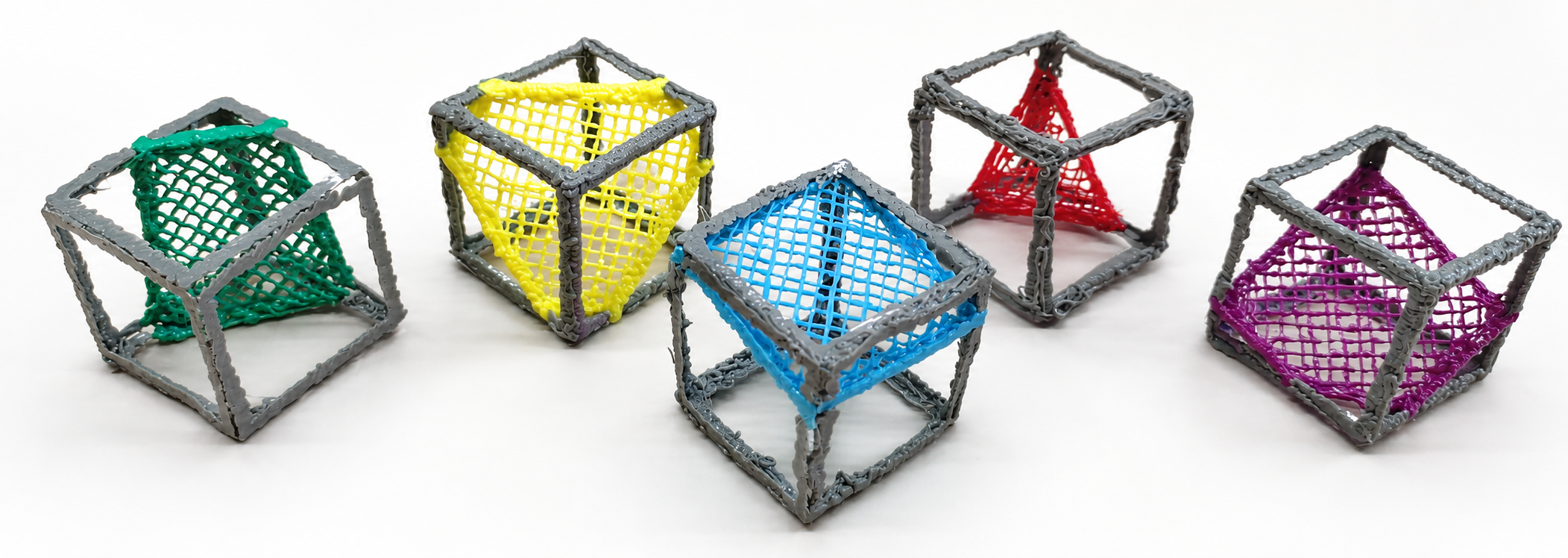
We are exploring the possibilities of using 3D printing technologies in teaching geometry at elementary and secondary schools. We focus on developing spatial imagination and understanding of spatial geometric concepts through work with 3D pens and 3D-printed models. The research focuses primarily on teaching stereometry, solving problems involving cross-sections of solids, and connecting two-dimensional representations with three-dimensional objects. We design methodological procedures, create templates and teaching materials for working with 3D pens, and verify their effectiveness through pedagogical experiments. The research also includes an analysis of students’ strategies and typical errors when solving stereometric problems.
Inclusive Education
We conduct research on the use of 3D printing technologies in the education of students with visual impairments. We design and test personalized tactile models that allow blind and visually impaired students to explore geometric objects through touch. The models are developed in collaboration with specialized schools and are designed according to the needs of specific students and instructional topics. We investigate their usefulness in teaching geometry, their contribution to the development of spatial mathematical concepts, and the possibilities for their integration into inclusive education.

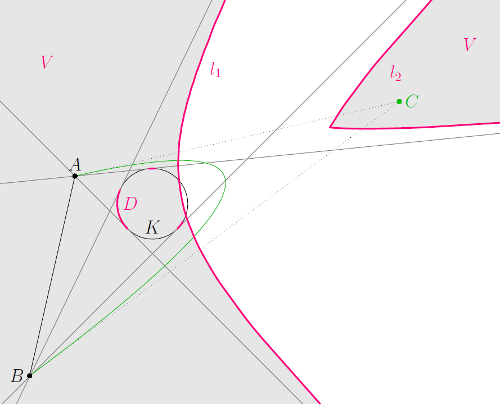
The mutual position of a Bézier curve and regular quadric
We work in three dimensional space in which a regular quadric is placed. There are two arbitrary points out of quadric. We find a set of all Bézier curves connected these two points such that this path and the regular quadric have no intersection. The spatial problem can be reduced to a planar problem where the the regular quadric is represented by a conic section.
Our method offer a direct computation of all possible collision-free smooth paths without using sample-based planning algorithms. We assume an obstacle represented by regular quadric and given start and end position of robot. We find all quadratic Bézier curves reflect the set of collision-free paths.
There is another use for the affine three dimensional Minkowski space typically determined by a light cone. The points lying outside the cone are called space-like. If we take two space-like points as first and last control points, we can find all quadratic pointwise space-like Bézier curves.